
The Power of Pause: Why Children Need Thinking Space in Classrooms
“The Power of Pause: Why Children Need Thinking Space in Classrooms”
In today’s fast-paced educational environment, classrooms are often driven by the urgency to complete syllabi, prepare for assessments, and maintain constant engagement. Teachers move swiftly from one activity to another, ensuring that every minute is filled with instruction or task completion. While this approach may appear productive, it often leaves little room for one of the most essential components of learning—the pause.
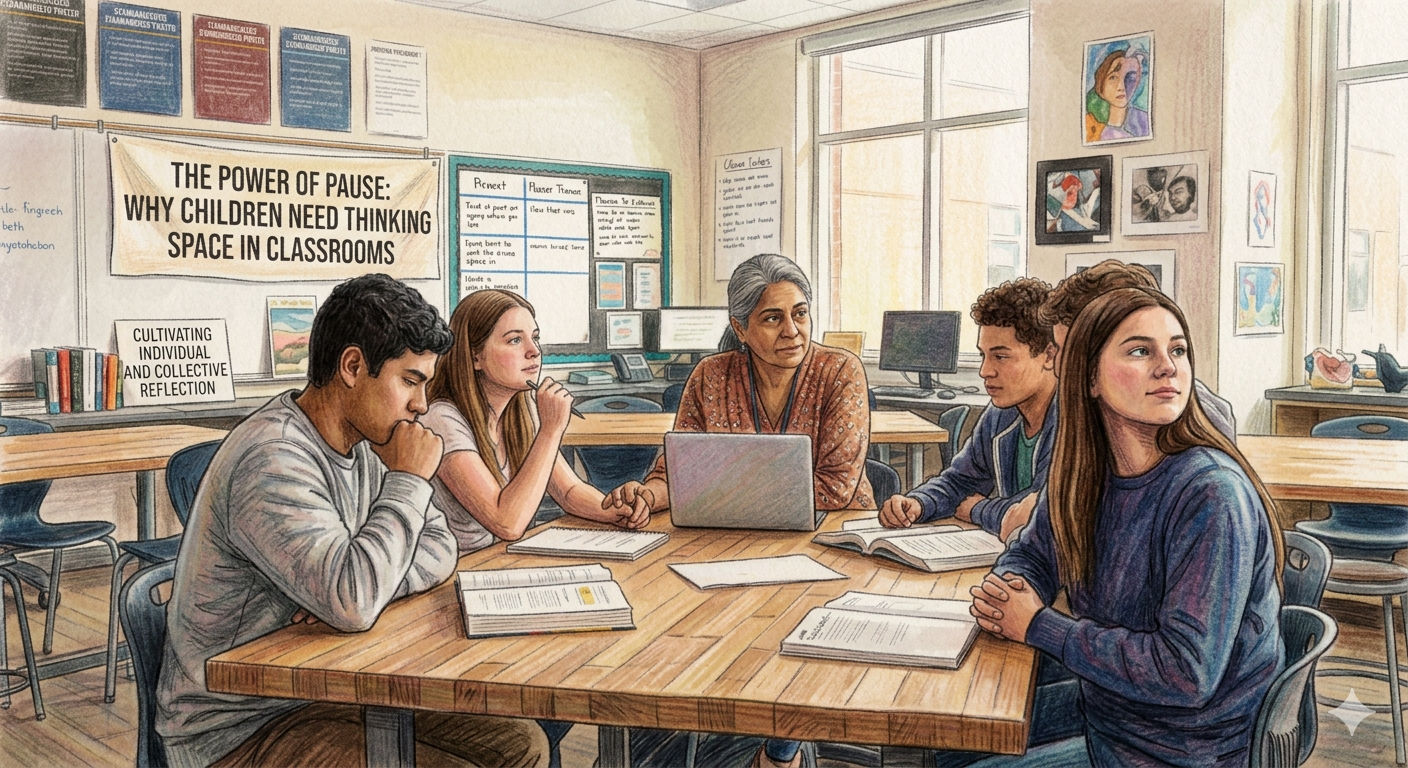
A pause in the classroom is not a sign of inactivity or wasted time; rather, it is a powerful space where thinking, reflection, and deeper understanding begin to take shape. Children, much like adults, require moments to process information, connect ideas, and internalize learning. When the pace of teaching is relentless, students may absorb information superficially without truly understanding it.
An analogy from nature helps illustrate this idea. Learning is much like planting a seed. A gardener does not continuously dig the soil or pour water endlessly. Instead, the seed is given time beneath the soil to absorb nutrients, settle, and gradually sprout. If the gardener keeps disturbing the soil in impatience, the seed may never grow. Similarly, when teachers constantly fill every moment with explanations and instructions, children rarely get the quiet space needed for ideas to take root and grow. The pause becomes the fertile soil where understanding slowly blossoms.
Thinking space allows learners to move beyond memorization. When a teacher pauses after asking a question, it gives children the opportunity to reflect, analyze, and construct their own responses. Even a few seconds of thoughtful silence can significantly improve the quality of student responses and participation. Students who may otherwise hesitate begin to feel confident enough to articulate their thoughts.
Moreover, pauses nurture curiosity. In classrooms where silence is accepted and valued, children feel encouraged to wonder, question, and explore ideas. Instead of rushing to provide answers, teachers can use pauses to allow students to discover solutions themselves. This not only strengthens their problem-solving abilities but also cultivates independent thinking.
Another important aspect of the pause is its role in emotional well-being. Modern learners are often overwhelmed by information, expectations, and distractions. Short reflective moments during lessons—whether through journaling, quiet observation, or reflective questioning—help students settle their thoughts and engage more meaningfully with the learning process. These moments create a calmer classroom environment where children feel safe to think and express themselves.
Practical classroom strategies can help integrate the power of pause into daily teaching. Teachers might pause for a few seconds after posing a question before inviting responses. Reflection breaks during lessons can encourage students to write or think about what they have learned. Think–pair–share activities also allow students to organize their ideas before speaking. Even a brief moment of silence after a story, experiment, or discussion can deepen understanding.
The pause also benefits teachers. It allows educators to observe students’ reactions, notice their thinking processes, and adapt their teaching accordingly. By stepping back momentarily, teachers gain valuable insights into how students learn and where they may need support.
Education should not merely be about covering content; it should be about cultivating thoughtful, reflective individuals. In a world that constantly demands speed and productivity, classrooms can become rare spaces where children learn the value of slowing down, thinking deeply, and engaging meaningfully with knowledge.
Ultimately, the power of pause reminds us that learning does not always happen in moments of constant activity. Sometimes, the most profound understanding emerges in the quiet spaces between words—when children are simply given the time to think.
By embracing the pause, educators can transform classrooms into environments where curiosity thrives, ideas grow, and learning becomes a thoughtful journey rather than a hurried race.
ABOUT THE AUTHOR :-
Ms. Ruchi Sachar
I am an educationist whose journey has been shaped by resilience, learning, and transformation. As a single mother, I began my professional path as an entrepreneur and spent nearly a decade gaining valuable experience in building and managing my work independently. Those years strengthened my confidence, adaptability, and determination.
After a phase of professional slowdown, I chose to redirect my path toward education. I started my journey in this field as a teacher and gradually grew into the role of an Academic Coordinator. During this time, I discovered a deep interest in understanding how children learn and how meaningful learning environments can be created.
My experiences in classrooms and with teachers ignited a strong curiosity within me to study education more deeply and bring thoughtful changes to teaching practices. I believe in being a lifelong learner, constantly exploring new ideas, reflecting on my work, and striving to make education more engaging, compassionate, and meaningful for children.