
Magic or Mirage? The Double–Edged Sword of Simulation in Education
Simulation-Based Learning in Education – Magic or Mirage
By Dr. Lalitha Ragul, Assistant Professor, School of Psychological Sciences, CHRIST (Deemed to be University), Bangalore
Introduction
The traditional classroom setups, be it school education or higher education in India, are mostly rooted within four walls, a blackboard, and rows of desks. Simulation-Based Learning in Education has emerged as a revolutionary method, offering immersive, safe, and hands-on skill development. The chalk-and-talk method by a teacher directs the flow of knowledge, where concepts are explained verbally while simultaneously drawn or written on the blackboard.
Even with the latest digital innovations like digital boards and digital content, the traditional method of teaching holds a substantial position in the education system.
In the ancient Gurukul system, though rote learning (simple memorization) was a major component, it offered hands-on learning in classical arts, Ayurveda, carpentry, weaving, etc., to provide holistic development to students.
In the modern classroom setup, the provision for hands-on learning is rendered in the form of simulation. SBL is magical as it’s a revolutionary force in education — promising safer, faster, and more immersive skill development.
Why Simulation-Based Learning in Education is a Magic
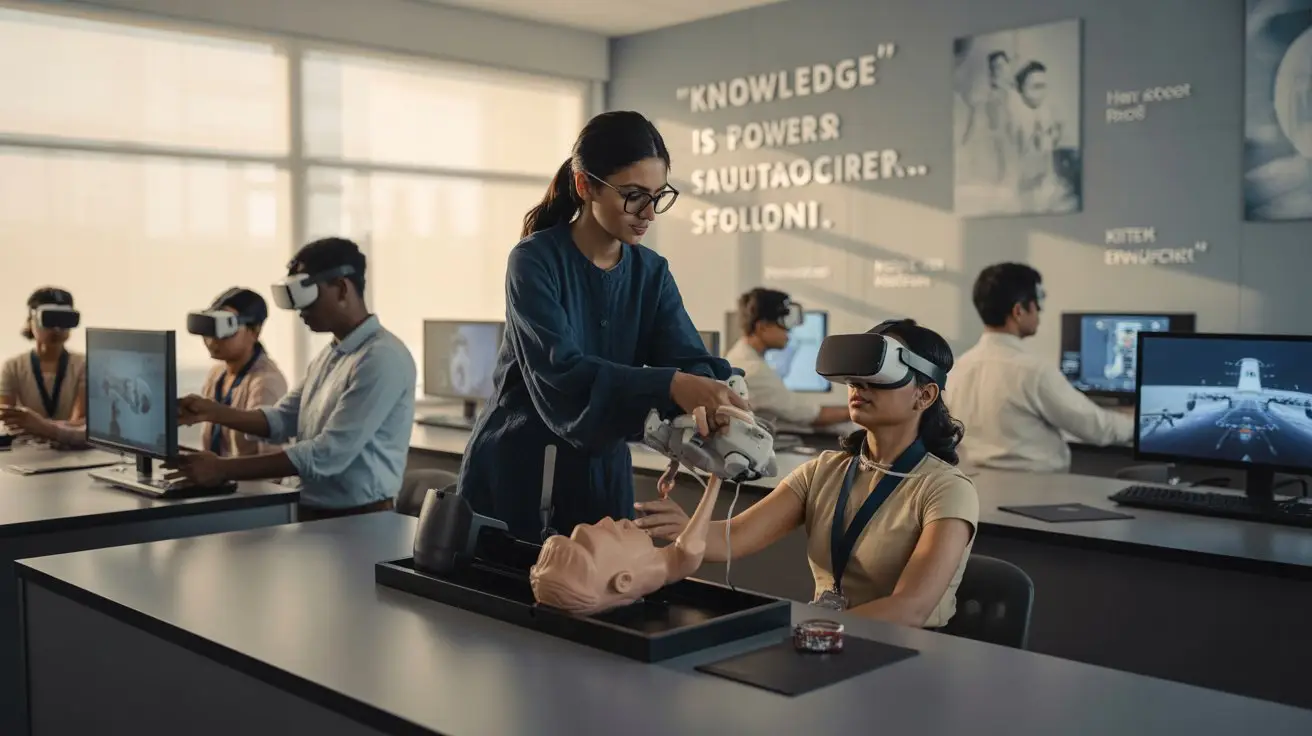
Simulation-based instruction provides learners the opportunity to engage in realistic, controlled, and interactive scenarios that mimic real-world situations.
The appeal of SBL lies in its zero-consequence environment for mistakes. Examples include:
- Manikin training in medical education
- 3D computer-based environments for virtual reality surgery practice
- Mock crime scenes for law schools
- Flight simulators for pilots
These scenarios cannot be effectively practiced in real-world settings. Simulation-Based Learning in Education builds confidence before students encounter real situations. Learners can replay scenarios until mastery is achieved and receive instant feedback that traditional classrooms cannot match.
This high-quality experiential learning in classrooms through simulation is undeniably magical and a revolutionary force in education.
When Simulation-Based Learning in Education Could Become a Mirage
The promise of “realistic cutting-edge education” could turn into a mirage when technology is overemphasized over theoretical knowledge. Flashy tools without sound instructional design may entertain but fail to educate.
Imported simulation models may overlook cultural context, resources, and learning needs of Indian students. For students from rural and urban backgrounds, this could create disparities in practice levels and make collaboration difficult.
Immense practical skill without a solid theoretical foundation is like “pouring water into a broken pot.” Even the most advanced, expensive simulation tools require trained educators to guide reflection and debriefing — bringing us back to the traditional chalk-and-talk method.
Conclusion: Simulation-Based Learning in Education
Simulation-Based Learning in Education is both magic and mirage — dazzling in its ability to immerse, engage, and prepare, yet imperfect in capturing the unpredictability and emotional nuance of the real world.
For contemporary India, the challenge is not to replace tradition but to fuse it with technology. Simulation-based learning becomes an extension of India’s heritage of experiential learning, rather than a substitute for traditional classroom teaching.
The key to a better future lies in balance — integrating simulations as a bridge between knowledge and application while ensuring learners still step into the messy, beautiful chaos of reality.