
National Education Policy 2020: Exploring the 5+3+3+4 Curriculum in 2025
National Education Policy 2020: Exploring the 5+3+3+4 Curriculum in 2025
The National Education Policy 2020 is revolutionizing Indian education, and its 5+3+3+4 curriculum structure is at the forefront of this change. Launched on July 29, 2020, and celebrated for its fifth anniversary on July 30, 2025, the National Education Policy 2020 introduces a holistic, flexible, and inclusive framework. Consequently, this structure is trending among students, parents, and educators for its focus on early learning, skill development, and reduced exam stress. In this article, we explore the 5+3+3+4 curriculum, its benefits, challenges, and what it means for India’s education system in 2025.
What Is the National Education Policy 2020’s 5+3+3+4 Curriculum?
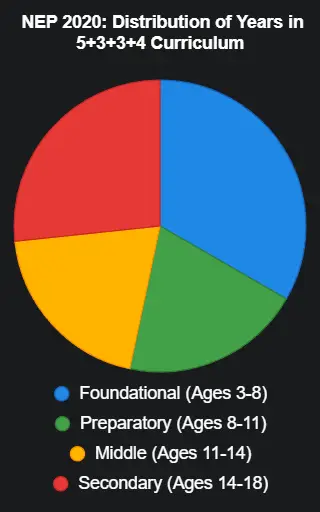
The National Education Policy 2020 replaces the traditional 10+2 system with a 5+3+3+4 model, aligning education with developmental stages. Here’s a breakdown:
- Foundational Stage (5 years, Ages 3-8): Includes 3 years of pre-school (Anganwadi) and Grades 1-2. It emphasizes play-based learning using tools like Jadui Pitara to build foundational literacy and numeracy, as per NIPUN Bharat goals.
- Preparatory Stage (3 years, Ages 8-11): Covers Grades 3-5, introducing subjects through interactive, activity-based learning to foster critical thinking and creativity.
- Middle Stage (3 years, Ages 11-14): Spans Grades 6-8, integrating vocational education (e.g., coding, agriculture) and multidisciplinary subjects to spark innovation.
- Secondary Stage (4 years, Ages 14-18): Includes Grades 9-12, offering flexible subject choices (e.g., science with arts) and biannual board exams to reduce pressure.
Source: Ministry of Education
Why the 5+3+3+4 Curriculum Is Trending in 2025
The National Education Policy 2020’s 5+3+3+4 structure is gaining attention for several reasons:
1. Revolutionizing Early Education
The Foundational Stage prioritizes early childhood care, aligning with NIPUN Bharat’s mission to achieve universal literacy and numeracy by Grade 2 by 2026-27. For example, Jadui Pitara kits, rolled out in 2025, make learning fun and engaging.
2. Empowering Student Choice
The Secondary Stage allows students to mix subjects across streams and take biannual board exams, a reform fully implemented in 2025. This flexibility reduces academic stress and aligns with the National Education Policy 2020’s vision.
3. Building Future-Ready Skills
Vocational education from Grade 6, a key feature of the National Education Policy 2020, prepares students for careers in fields like technology and hospitality. This aligns with India’s goal of a skill-based economy.
4. PM SHRI Schools Leading Implementation
The PM SHRI Schools initiative, upgrading 14,500+ schools with Rs. 630 crore in 2025, showcases the 5+3+3+4 curriculum with smart classrooms and trained teachers.
Benefits of the 5+3+3+4 Curriculum
The National Education Policy 2020’s 5+3+3+4 structure offers significant advantages:
- For Students: Holistic development, flexible subject choices, and career-ready skills.
- For Parents: Early education access and mother tongue instruction via Bharatiya Bhasha.
- For Educators: NISHTHA training programs enhance modern teaching methods.
Challenges Facing the National Education Policy 2020
Despite its promise, the National Education Policy 2020 faces hurdles:
- Infrastructure Gaps: Rural schools lack smart classrooms and trained teachers.
- Funding Shortfalls: Education spending is at 4% of GDP, below the 6% target.
- Standardization: Implementing the 5+3+3+4 model across 1.5 million schools is complex.
What’s Next for the 5+3+3+4 Curriculum?
By 2030, the National Education Policy 2020 aims to:
- Fully implement the 5+3+3+4 structure nationwide.
- Expand digital platforms like DIKSHA for personalized learning.
- Train 1 million teachers in NEP-aligned pedagogies through NISHTHA.
SHARING IS CARING