
R1, R2, R3 and the Language Debate: Is It Time to Rethink English in Indian Education?
R1, R2, R3 and the Language Debate: Is It Time to Rethink English in Indian Education?
By Dr. Poonam Saxena
Principal, Scholars Global School, Bahadurgarh
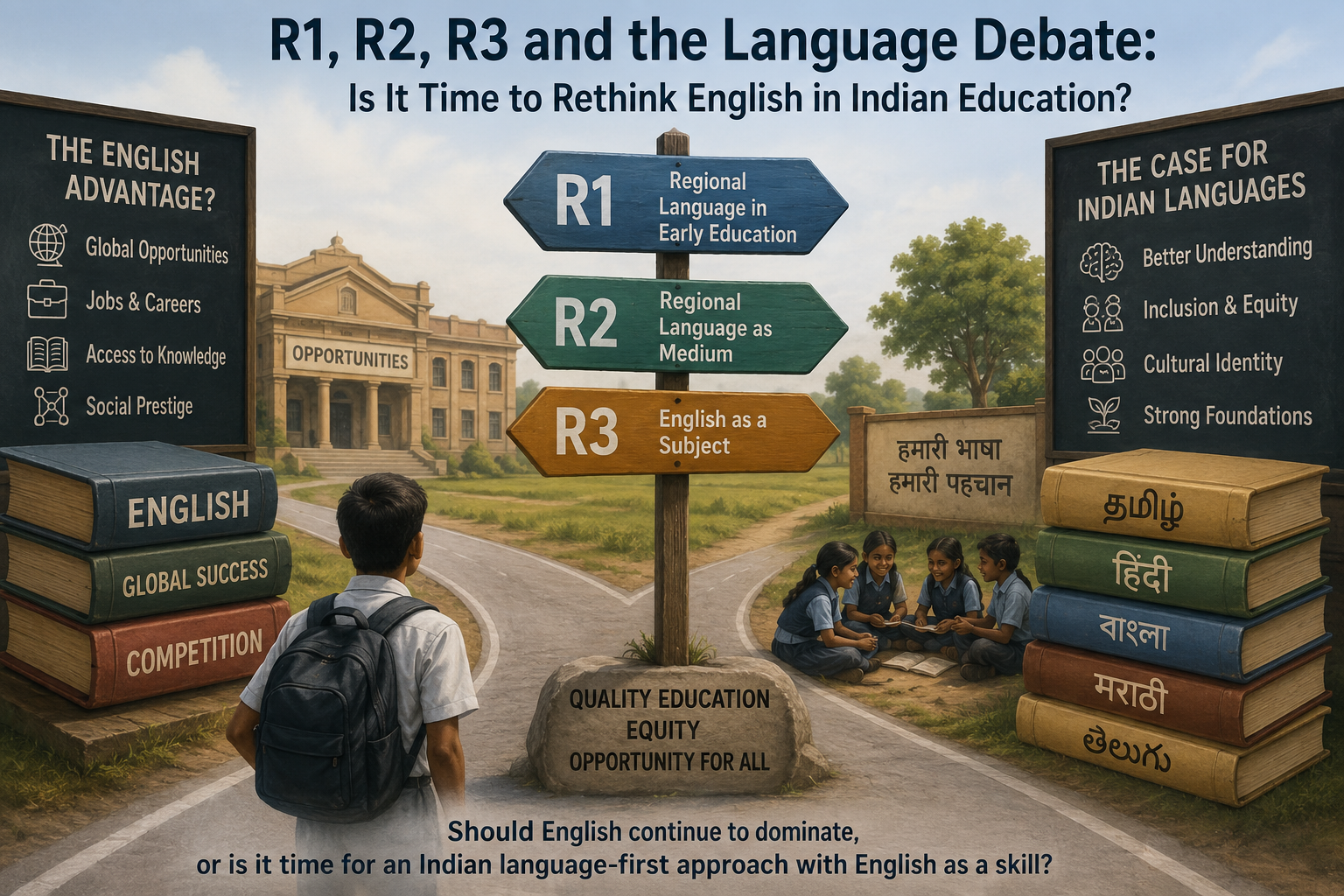
The introduction of the R1, R2, and R3 language structure under the new school curriculum has sparked widespread discussion among educators, school leaders, parents, and policymakers. While the intent of promoting multilingualism is commendable and aligns with the vision of the National Education Policy (NEP) 2020, its implementation raises several practical concerns, particularly for English-medium schools.
As the Principal of an English-medium school in Haryana, I find myself reflecting on a fundamental question:
How can English be treated as a foreign language when it is also one of India’s official languages?
The Ground Reality of English-Medium Schools
For decades, parents have chosen English-medium schools with a clear aspiration: to equip their children with strong communication skills, global competitiveness, and access to higher education opportunities across India and abroad.
In states such as Haryana, schools are already expected to promote Hindi and Sanskrit as important languages. Under the proposed framework, many schools may find themselves offering:
* English
* Hindi
* Sanskrit
This leaves little or no room for a genuinely foreign language such as French, German, Spanish, or Japanese.
The concern is not about preserving English at the cost of Indian languages. Rather, it is about acknowledging the unique status that English occupies in contemporary India.
English: Foreign Language or Indian Reality?
India’s Constitution recognizes Hindi and English as official languages for governmental and administrative purposes. English is widely used in:
* Parliament proceedings
* Higher education
* Judiciary
* Corporate communication
* Scientific research
* International diplomacy
More importantly, English often serves as a bridge language connecting citizens across states.
A student from Haryana may find it easier to communicate with a peer from Kerala, Tamil Nadu, or Mizoram through English than through any regional language. In many ways, English has evolved beyond its colonial origins and become an Indian language in practice.
After nearly three centuries of British rule and more than seventy-five years of independence, English continues to be deeply embedded in India’s educational, administrative, and professional systems.
Therefore, policymakers may need to reconsider whether English should continue to be categorized alongside foreign languages within the curriculum framework.
Talent Must Be Nurtured, Not Restricted
The National Education Policy repeatedly emphasizes nurturing individual talent and preparing learners for a rapidly changing world.
Research consistently demonstrates that multilingualism enhances cognitive flexibility, problem-solving skills, and cultural awareness. However, global competitiveness also depends on proficiency in languages that provide access to international knowledge networks.
According to reports by organizations such as the British Council and the World Economic Forum, English remains one of the most important languages for higher education, global employment, scientific publication, and international collaboration.
A significant proportion of advanced academic literature, research journals, technical manuals, and digital learning resources continues to be available primarily in English. Despite ongoing translation efforts, many specialized texts have yet to be translated into Indian languages.
If our goal is to nurture talent, we must ensure that students are not deprived of access to global knowledge ecosystems.
The Question of Choice
The strength of India’s educational system lies in its diversity.
A one-size-fits-all language model may not serve schools operating in vastly different contexts. A school in rural India, a metropolitan international school, and a school situated in a multilingual border region face very different realities.
Greater flexibility could be introduced by allowing schools to design language combinations based on:
* Regional requirements
* Student aspirations
* Parent expectations
* Availability of qualified teachers
* Institutional vision
Such flexibility would preserve the spirit of multilingualism while respecting local educational contexts.
The Human Impact: Teachers and Livelihoods
Policy changes often focus on students, but their impact on educators cannot be overlooked.
Across the country, many schools are already reconsidering the continuation of foreign language programs. Consequently, trained French, German, and other language teachers face uncertainty regarding their professional future.
Educational reforms should be implemented gradually, with clear guidelines and transition plans, ensuring that teachers are not adversely affected by sudden shifts in policy interpretation.
The Assessment Challenge
Another concern relates to the growing number of curricular requirements at the secondary level.
The curriculum now includes multiple skill-based, experiential, and interdisciplinary components. While these initiatives are educationally sound in principle, schools already operate under significant constraints of time, staffing, infrastructure, and resources.
When a large proportion of assessments become school-based and internally conducted, a natural question arises:
Will the focus remain on authentic learning, or will compliance gradually replace meaningful implementation?
Without adequate monitoring and support systems, there is a risk that activities may become documentation exercises rather than genuine learning experiences. This could ultimately dilute the quality and credibility of assessment outcomes.
A Balanced Way Forward
The objective should not be to choose between English and Indian languages. India needs both.
Hindi, Sanskrit, and regional languages preserve our cultural heritage, identity, and traditions. English provides access to global opportunities, higher education, research, and inter-state communication.
The challenge before policymakers is to create a framework that recognizes both realities.
Perhaps the solution lies in a more flexible interpretation of the R1–R2–R3 structure—one that allows schools to preserve linguistic diversity while acknowledging the unique position English occupies in modern India.
The debate is not about language dominance. It is about educational relevance, student aspirations, and preparing future generations for a world that is simultaneously local and global.
As educators, we support multilingualism. However, we must also ask whether it is time to formally recognize what millions of Indians already practice every day: English is no longer merely a foreign language—it has become an integral part of India’s linguistic landscape.
Dr. Poonam Saxena
Principal, Scholars Global School, Bahadurgarh