‘Curiosity’ by NCERT: Transforming Science Education with Competency-Based Learning’
The saying “Don’t judge a book by its cover” is well-known. Still, I challenge it by exploring “Class 6
Curiosity,” the NCERT-released science textbook, and uncovering the deeper significance behind the
cover page.
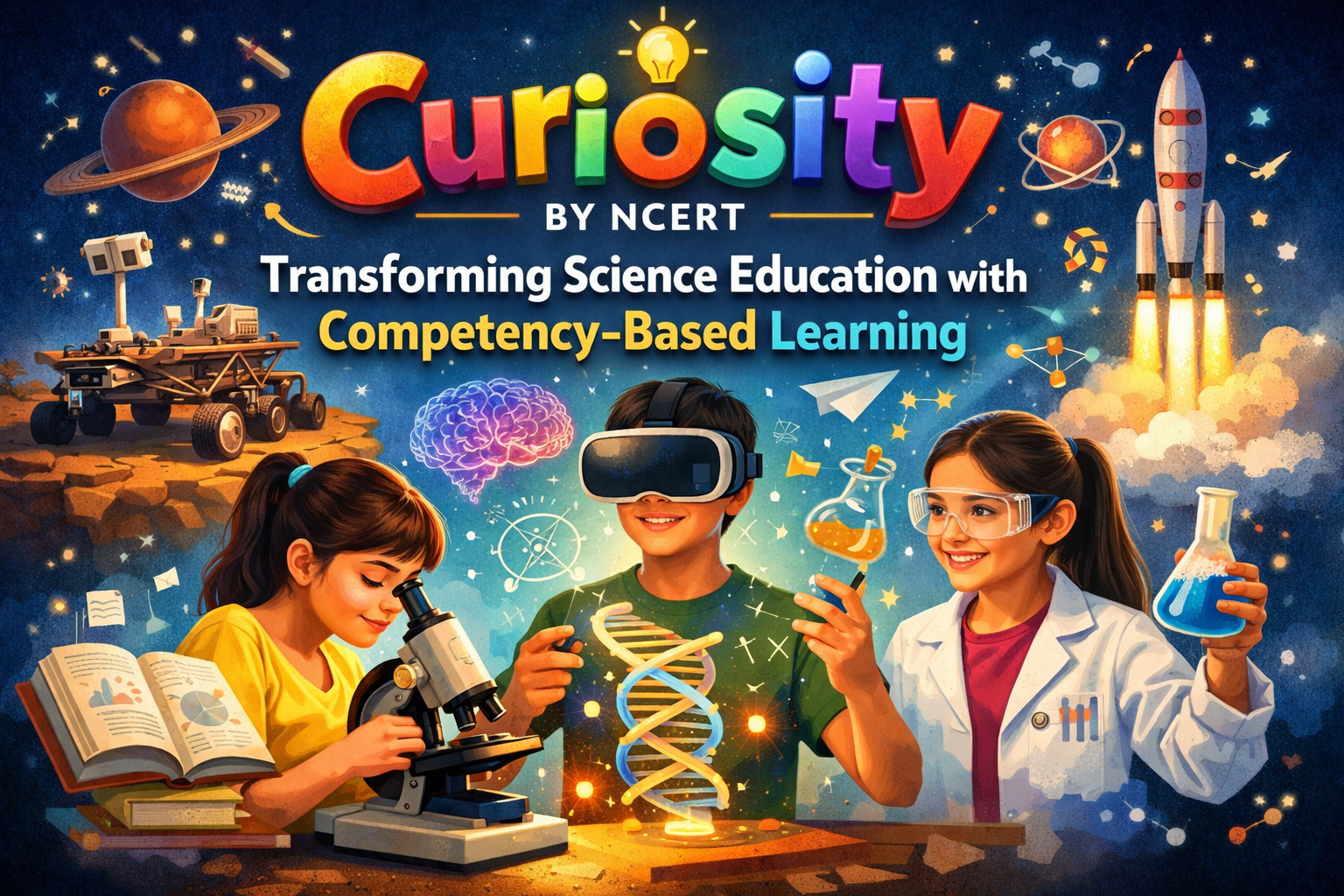
What I could interpret from the cover is that science and curiosity are closely connected. A major driver
of scientific research is curiosity, or the desire to learn about and investigate the unknown. It encourages
researchers to ask questions, develop hypotheses, and design experiments to better understand the
world around us. In science, curiosity sparks new lines of inquiry, fosters perseverance in facing
obstacles, leads to surprising discoveries, and promotes multidisciplinary relationships.
Open environments naturally foster discovery and stimulate curiosity. Students engaging in various
activities illustrate the book’s emphasis on an activity-based and student-centered approach.
NCERT’s new Class 6 Science textbook “Curiosity” marks a significant shift in India’s educational
landscape, aligning with the National Education Policy (NEP) 2020 and the National Curriculum
Framework for School Education (NCF-SE) 2023. This innovative textbook moves away from traditional
rote learning, adopting a holistic approach that combines competency-based learning with India’s rich
scientific heritage. Here are the key features of the new textbook.
In this article, we will explore two main aspects of the textbook: Competency-based learning and
integration of Indian Knowledge Systems (IKS).
⮚ Shaping Education Through Competencies
Competency-based learning (CBL), the core focus of the textbook, is demonstrated through carefully
designed elements that emphasize skill development over memorization. Through interactive exercises,
real-world applications, and practical experiments, students are exposed to scientific concepts. For
example, instead of just learning the definition of photosynthesis, students conduct hands-on
experiments to see how plants adapt to different environments.
A redesigned evaluation approach focuses on higher-order thinking skills. Case studies and real-world
issues requiring analytical and critical thinking replace traditional question-answer formats. For instance,
students studying the water cycle may address actual water scarcity problems by applying their
knowledge of evaporation and condensation to propose solutions.
⮚ Connecting Contemporary Science and Traditional Wisdom
“Curiosity” uniquely blends modern scientific ideas with Indian Knowledge Systems (IKS). The textbook
highlights India’s impressive scientific legacy through examples, such as:
- The Iron Pillar of Delhi, demonstrating ancient advanced metallurgy techniques.
- Traditional water conservation methods like step-wells (baolis) and check dams (Johads), presented
alongside contemporary sustainability concepts, emphasize the value of Indigenous wisdom in solving
today’s environmental challenges.
It also explains scientific rationales behind traditional medicine and Ayurvedic concepts, such as the use
of turmeric and neem. This helps students appreciate how traditional practices align with current
scientific understanding.
⮚ Developing 21st-Century Skills
“Curiosity” encourages debates and group projects to develop teamwork and effective communication.
By integrating physics, mathematics, social sciences, and environmental studies, the interdisciplinary
approach fosters a comprehensive understanding of scientific ideas.
Regular “Think and Reflect” sections promote self-assessment and help students evaluate their
understanding and consider real-world applications, supporting the development of metacognitive skills
essential for lifelong learning.
⮚ The Curiosity textbook represents a paradigm shift in science education, making it more learner-
centric, application-based, and competency-driven. By fostering critical thinking, problem-solving,
collaboration, and real-world application skills, it ensures students develop not just knowledge but the
skills to succeed in a constantly changing world.
⮚ The textbook also integrates India’s rich scientific heritage with modern scientific knowledge, helping
students appreciate India’s contributions to global science. Embedding IKS within various chapters
ensures learning remains both globally relevant and deeply rooted in indigenous knowledge.
⮚ In conclusion, this new Class 6 Science textbook is a progressive step toward modernizing science
education in India. Its alignment with NEP 2020 and NCF-SE 2023 guarantees a holistic, culturally
enriched, and competency-based education, preparing students to navigate and contribute effectively to
the contemporary world.
Written by
Shubhangi Raajput
Curriculum Development Manager, Aditya Birla Education Academy, Gujarat Project